
Commercial and recreational drone pilots alike can whip themselves into a frenzy, capturing snapshot after snapshot or long stretches of video.


It’s easy to get carried away, whether for enjoyment or work, until you’re hit with a brutal reality. The drone has run out of storage.
Enter SD cards.
What is an SD card, and how does it work in a drone? Drone SD cards provide additional storage between 32 gigabytes and 1 terabyte, allowing pilots more space for recording and saving photos and videos.
It’s simple enough on the surface, but I plan on digging as deep into drone SD cards as you can go, so join me!

To help, we’ve identified and reviewed the best drone courses for beginners and professionals.

What are SD cards, and why do drones need them?
Let’s get underway by expanding on the definition of SD cards from the intro.
An SD card is called a Secure Digital card in full. It’s a type of flash memory card created for all sorts of devices, drones included.
You can also use SD cards for computers, laptops, music players, digital cameras, and smartphones.
Unlike most of those devices, which offer gigabytes and gigabytes of storage space, a drone does not.
It varies by model, but most are limited to 8 gigabytes of internal storage space.
You know how little 8 gigabytes is if you own a personal computer or smartphone. That can go very fast.
Running out of storage space is not an option when you’re out in the field.
Recreationally, it’s a bummer, but it’s even more damning professionally. You might not be able to finish your project, putting you behind on your deadlines and possibly costing you the gig and that client.
It’s not as easy as going back home (or to the office), dumping your footage on your computer, and coming back.
That takes time, and if you’re in an unprecise location, finding it again and returning to your exact spot so your footage has continuity can be difficult.
An SD card has your back.
After you inevitably chew through the 8 gigabytes of storage space your drone allots you (especially if you’re recording or photographing in the highest quality available in your drone), the SD card will continue storing your footage so you don’t have to miss a beat.
» MORE: SD Cards for DJI Drones (What You Need to Know)
What type of SD cards do drones use?
Drones often use microSD cards, a miniaturized version of traditional SD cards. The micro version can fit into small electronics, a category many drone models fit.
Since they’re so much smaller, microSD cards can’t hold as much storage as a traditional large SD card.
The limit is currently 1 terabyte but will likely increase to 2 terabytes soon.
Honestly, for most drone applications, 1 TB of space is more than enough. The equivalent of 1 TB is 1,000 gigabytes, so it’s quite a lot of storage space.
When microSD cards eventually store up to 2 TB, those cards will be capable of containing the equivalent of 2,000 MB.
If your drone has a standard SD slot, you can use a microSD card in its place with an adapter. The adapter allows the drone to read and write to the microSD card as though it were larger.
» MORE: Best SD Cards for DJI Mavic 3 (Class/Pro/Cine)
What format of SD cards do drones use, FAT32 or exFAT?
Next, let’s discuss SD card format, including exFAT and FAT32.
You must know the difference when shopping for SD or microSD cards.
FAT32 SD card format
FAT32 is not the OG, as that’s technically 8-bit FAT. Then we got FAT12, then FAT16, and next, FAT32.
This file system has a greater volume size limit than FAT16 but not a bigger limit than exFAT.
Its max volume size is 8 TB, still more than enough for most drone operations, but a great deal less than exFAT (as you’ll see).
» MORE: DJI Avata – How to View and Transfer Video
exFAT SD card format
Extensible File Allocation Table or exFAT is one of two SD card file systems. This format is also applicable for flash memory drives, including USB drives.
Microsoft debuted the exFAT format in 2006, making it the newer version of FAT32.
It offers a larger file limit size of 16 exabytes, with one EB the equivalent of a million GB.
You can use exFAT SD and microSD cards on Windows and Apple devices.
The switch to exFAT also improved card formatting, such as introducing templated metadata, using checksums for better metadata integrity, increasing the cluster size to 32 GB, using two lengths fields for pre-allocating valid data length, and TexFAT support.
TexFAT is short for Transaction-Safe Extended FAT File System and relies on the same file system the exFAT format utilizes.
» MORE: DJI Mini 3/Pro – How to Transfer Videos/Photos to a Windows PC (Video)
FAT32 or exFAT, which should your drone use?
As the successor to FAT32, exFAT has phenomenal advantages.
Its minimum cluster count is 232 versus FAT32’s 228, its max cluster size is 32 MB compared to 32 KB for FAT32, and exFAT has a much higher max file size and volume size.
However, FAT32 is often the more compatible system. Some devices have exFAT support, but not all.
Formatting an SD or microSD card to FAT32, in that case, is the safer bet.
» MORE: How to Format SD Cards in DJI Drones (Quick Steps with Photos)
What is the best SD card capacity for your drone?
You don’t necessarily need the greatest SD card capacity for a drone.
It depends on several factors, including the length of the footage, the quality, and the drone manufacturer’s specifications.
For example, DJI recommends drone pilots use a microSD or SD card with at least 128 GB of storage.
The card should have a UHS bus for 4K videos shot at 60 to 120 frames per second and UHS-I Speed Grade 3 when shooting in 1080p.
» MORE: Best SD Cards for DJI Mini 2 SE
What if your SD card has less storage capacity than that? That’s more likely with a microSD card.
You can use an SD card with less storage, but you should expect lower footage quality.
For non-DJI drones, here’s a good rule of thumb. Use a card with UHS-1 Video Speed Class V30 and a write speed of up to 70 MB a second when taking 4K UHD or HD video footage.
If you’re taking high-res images or videos in 4K or 8K quality, use an SD card with UHS-II Video Speed Class V90 and 165 MB per second of write speed.
SD cards for DJI drones
Next, let’s get into SD card specifics so you can start shopping.
I’ll look at three major drone manufacturers and several drone models, with recommended SD cards for each, beginning with DJI.
DJI Air 3
The DJI Air 3 is one of the latest and greatest creations from DJI. It includes a dual-camera system with a wide-angle and medium tele-camera and a 1/1.3-inch CMOS sensor.
The cameras can shoot videos in 4K at 60 fps HDR and 48 MP for images.
This DJI drone also boasts the O4 HD video transmission system, omnidirectional obstacle sensing, and a flight time of over 45 minutes.
DJI recommends the following SD cards for the Air 3:

- Fast read speed up to 170MB/s and write speed up to 70MB/s
- Speed Class 10, UHS-I, V30, A2 for high-performance and full HD video recording
- Water proof, magnet proof, temperature proof, and x-ray proof
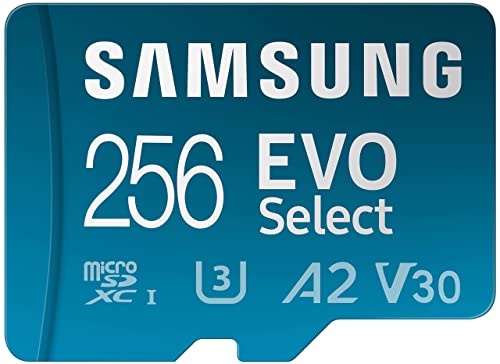
- Superfast U3, class 10 rated transfer speeds of up to 130MB/s¹,²and UHS-I Interface
- Available in 64GB, 128GB, 256GB, and 512GB
- Complete with water⁴, temperature⁵, X-ray⁶, ⁷magnet, drop⁸, and wears⁹ out protection; Backed by a 10-year limited warranty

- Professional-level performance for action cameras, drones, or Android smartphones
- Leverages UHS-I technology to deliver read speeds up to 160MB/s (1066x)
- Designed for durability in harsh conditions

- Write Speeds of up to 140MB/s: Capture fast-action photos or shoot 4K UHD video with write speeds of up to 140MB/s.
- Load Apps Faster with A2
- This card is shockproof, temperature-proof, waterproof, and X-ray-proof

- Up to 130MB/s write speeds for fast shooting
- 4K and 5K UHD-ready with UHS Speed Class 3 (U3) and Video Speed Class 30 (V30)
- Rated A2 for faster loading and in-app performance
» MORE: Best SD Cards for DJI Air 3
DJI Avata
Fly free with the DJI Avata, one of DJI’s first FPV drones.
Avata has low-latency video transmission at 10 KM in 1080p quality, prop guards, video stabilization, and motion controls.
It also weighs 410 grams, which is light for an FPV drone.
Avata shoots in 4K at 60 fps, capturing super-wide 155-degree FOV video footage. So, what SD cards does it use? I’m glad you asked! Here’s a list to get you started.


» MORE: Best SD Cards for DJI Avata
DJI Inspire 2
A classic DJI drone, the Inspire 2 features high-quality image processing at 5.2K in Apple ProRes and CinemaDNG RAW.
It has two batteries for a moderate flight time of 27 minutes and can reach top speeds of 58 miles per hour. It even includes self-heating technology.
Use the SanDisk Extreme PLUS 64GB for the Inspire 2, with storage space up to 128 GB if you need more.

» MORE: What SD Card Do I Need for DJI Inspire 2?
SD cards for Autel drones
Perhaps you prefer Autel drones like the EVO series.
Let’s review which SD cards are recommended for the top drone models from this manufacturer.
EVO II
The EVO II is a foldable drone capable of recording in 7680×4320 resolution and 8K quality, producing 33 million pixels.
Its 48-MP Sony sensor is one of the best aerial cameras on the market.
Autel equipped the EVO II with single-frame merged exposures that combine short-, medium-, and long-term exposures.
The 10-bit color depth enriches all your footage.
Try these SD cards for the EVO II:
- Write Speeds of up to 140MB/s: Capture fast-action photos or shoot 4K UHD video with write speeds of up to 140MB/s.
- Load Apps Faster with A2
- This card is shockproof, temperature-proof, waterproof, and X-ray-proof
- Professional-level performance for action cameras, drones, or Android smartphones
- Leverages UHS-I technology to deliver read speeds up to 160MB/s (1066x)
- Designed for durability in harsh conditions
EVO Nano+
The ultra-popular EVO Nano+ from Autel is the successor of the original Nano.
This 249-gram drone includes features like a 64GB SD storage card, three-way obstacle avoidance, a three-axis gimbal, CDAF and PDAF focusing, and a 4K RYYB camera.
This drone is also available in a bundle with plenty of features and accessories, making it a cost-effective choice for any drone pilot.
You can upgrade to a 128GB card with some Nano+ bundles, but if that still isn’t enough storage, try the following SD and microSD cards:
- Professional-level performance for action cameras, drones, or Android smartphones
- Leverages UHS-I technology to deliver read speeds up to 160MB/s (1066x)
- Designed for durability in harsh conditions